BOLFOR, Proyecto de Manejo Forestal Sostenible. 4to Anillo esq. Av. 2 de Agosto, Casilla 6204, Santa Cruz, Bolivia | Museo de Historia Natural Noel Kempff Mercado y Wildlife Conservation Society. Av. Irala 565, Casilla 2489, Santa Cruz, Bolivia
Damian I. Rumiz
BOLFOR, Proyecto de Manejo Forestal Sostenible. 4to Anillo esq. Av. 2 de Agosto, Casilla 6204, Santa Cruz, Bolivia | Museo de Historia Natural Noel Kempff Mercado y Wildlife Conservation Society. Av. Irala 565, Casilla 2489, Santa Cruz, Bolivia
Todd S. Fredericksen
BOLFOR, Proyecto de Manejo Forestal Sostenible. 4to Anillo esq. Av. 2 de Agosto, Casilla 6204, Santa Cruz, Bolivia
Nell J. Fredericksen
BOLFOR, Proyecto de Manejo Forestal Sostenible. 4to Anillo esq. Av. 2 de Agosto, Casilla 6204, Santa Cruz, Bolivia
Bolivia bosque semideciduo chiquitano claros de aprovechamiento forestal manejo de bosques riqueza
Cómo citar
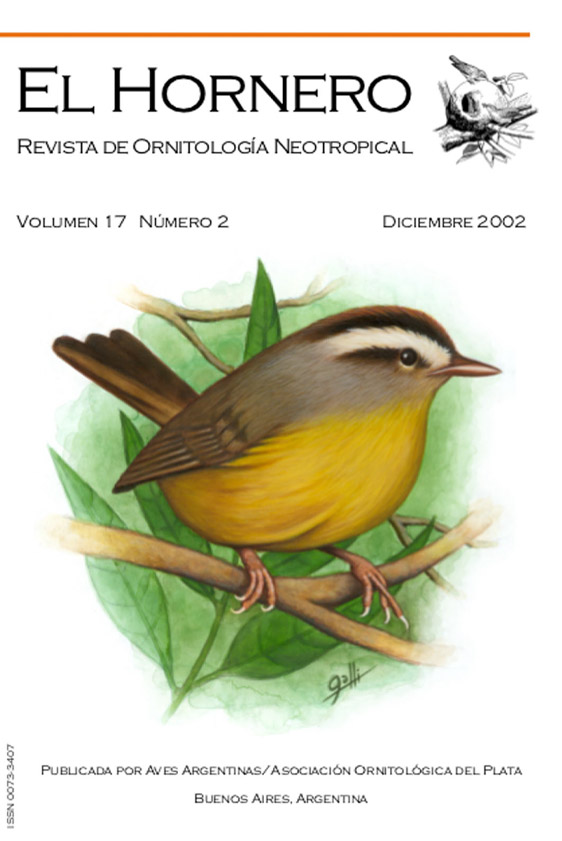
Flores, Betty, Damian I. Rumiz, Todd S. Fredericksen, and Nell J. Fredericksen. 2002. “El Uso De Claros De Aprovechamiento Forestal Por La Avifauna De Un Bosque Semideciduo Chiquitano De Santa Cruz, Bolivia”. El Hornero 17 (2): 61-69. https://doi.org/10.56178/eh.v17i2.872.
Se realizó un estudio en un bosque seco o semideciduo chiquitano de la región de Lomerío, a un año de una extracción forestal selectiva de baja intensidad. Evaluamos la riqueza, diversidad, abundancia relativa y representación de gremios de aves (126 individuos de 32 especies) capturadas con redes de niebla en claros de extracción de dos tamaños y en sitios adyacentes sin extracción. La riqueza, abundancia y diversidad de especies mostraron una disminución consistente desde los claros grandes, a claros chicos y a sitios sin extracción, aunque las diferencias entre tratamientos no siempre fueron significativas. Los insectívoros Thamnophilus sticturus, Cnemotriccus fuscatus y Thryothorus guarayanus fueron las aves más frecuentes en los claros grandes, mientras que Thamnophilus sticturus, Sittasomus griseicapillus, Thryothorus guarayanus y Basileuterus culicivorus fueron las especies más capturadas en los claros chicos y en los sitios sin extracción. De ocho gremios examinados, sólo la abundancia de los insectívoros que capturan su presa en el aire fue mayor en los claros; los restantes gremios no presentaron diferencias significativas entre tratamientos. Las actividades de aprovechamiento forestal aparentemente no causaron fuertes impactos en la comunidad de aves en el área de estudio después de un año. Sin embargo, los cambios cualitativos podrían ser sutiles y pasar desapercibidos en este plazo, y ser notables solo después de muchos años.
BAZZAZ FA (1990) Regeneration of tropical forest: physiological responses of pioneer and secondary species. Pp. 91–118 en: GÓMEZ-POMPA, WHITMORE ATC Y HADLEY M (eds) Rain forest regeneration and management. UNESCO y The Parthenon Publishing Group, París.
BLAKE JG Y HOPPES WG (1986) Influence of resource abundance on use of tree-fall gaps by birds in an isolated woodlot. Auk 103:328–340.
CORO PQ (2000) Comunidad de insectos voladores en áreas con diferentes grados de perturbación forestal en un bosque tropical seco de Santa Cruz. Tesis de grado. Universidad Mayor Real y Pontificia de San Francisco Xavier de Chuquisaca, Sucre.
DAVIS S (1993) Seasonal status, relative abundance, and behavior of the birds of Concepción, Departamento de Santa Cruz, Bolivia. Fieldiana Zoology 71:1–33.
DINERSTEIN E, OLSON DM, WEBSTER AL, PRIMM SA, BOOKBINDER MP Y LEDEC G (1995) A conservation assessment of the terrestrial ecoregions of Latin America and the Caribbean. World Wildlife Fund y The World Bank, Washington DC.
FLORES B, RUMIZ DI Y COX G (2001) Avifauna del bosque semideciduo Chiquitano (Santa Cruz, Bolivia) antes y después de aprovechamiento forestal selectivo. Ararajuba 9:21–31.
GALLI A, LEK C Y FORMAN R (1976) Avian distribution patterns in forest islands of different sizes in central New Jersey. Auk 93:356–364.
GOTELLI NJ Y GRAVES GR (1996) Null models in ecology. Smithsonian Institution Press, Washington DC.
HILTY SL Y BROWN WL (1986) Birds of Colombia. Princeton University Press, Princeton.
JOHNS AD (1985) Selective logging and wildlife conservation in tropical rain-forest: problems and recommendations. Biological Conservation 31:355–375.
KARR JR (1981) Surveying birds with mist nets. Studies in Avian Biology 6:62–67.
KARR JR (1990) The avifauna of Barro Colorado Island and the Pipeline Road, Panamá. Pp. 183–198 en: GENTRY AH (ed) Four Neotropical rainforests. Yale University Press, London.
KILLEEN TJ, JARDIM A, MAMANI F Y ROJAS N (1998) Diversity, composition and structure of a tropical semideciduous forest in the Chiquitanía region of Santa Cruz, Bolivia. Journal of Tropical Ecology 14:803–827.
LAMBERT FR (1992) The consequences of selective logging for Bornean lowland forest birds. Philosophical Transactions of the Royal Society of London 335:443–457.
LEVEY DJ (1988) Tropical wet forest treefall gaps and distribution of understory birds and plants. Ecology 69:1076–1089.
LEVEY DJ (1990) Habitat-dependent fruiting behaviour of an understorey tree, Miconia centrodesma, and tropical treefall gaps as keystone habitats for frugivores in Costa Rica. Journal of Tropical Ecology 6:409–420.
MCCUNE B Y MEFFORD MJ (1997) Multivariate analysis of ecological data. Version 3.0. MjM Software, Gleneden Beach.
MARSDEN SJ (1998) Changes in bird abundance following selective logging on Seram, Indonesia. Conservation Biology 12:605–611.
MASON DJ (1996) Responses of Venezuelan understory birds to selective logging, enrichment strips, and vine cutting. Biotropica 28:296–309.
MASON DJ Y THIOLLAY JM (2001) Tropical forestry and the conservation of Neotropical birds. Pp. 167–191 en: FIMBEL RA, GRAJAL A Y ROBINSON JG (eds) The cutting edge: conserving wildlife in logged tropical forests. Columbia University Press, New York.
MOSTACEDO B, FREDERICKSEN T Y TOLEDO M (1998) Respuestas de las plantas a la intensidad de aprovechamiento en un bosque semideciduo pluvio-estacional de la región de Lomerío, Santa Cruz, Bolivia. Revista de la Sociedad de Botánica 2:75–88.
NAROSKY T E YZURIETA D (1987) Guía para la identificación de las aves de Argentina y Uruguay. Asociación Ornitológica del Plata, Buenos Aires.
NAVARRO G (1997) Contribución a la clasificación ecológica y florística de los bosques de Bolivia. Revista Boliviana de Ecología y Conservación Ambiental 1:3–37.
NOSS RF Y SCOTT JM (1997) Ecosystem protection and restoration: the core of ecosystem management. Pp. 239–264 en: BOYCE MS Y HANEY A (eds) Ecosystem management: applications for sustainable forest and wildlife resources. Yale University Press, New Haven.
PARKER TA III, GENTRY AH, FOSTER RB, EMMONS LH Y REMSEN JV JR (1993) The lowland dry forests of Santa Cruz, Bolivia: a global conservation priority. RAP Working Papers 4:1–104.
PLUMPTRE A, DRANZOA C Y OWIUNJI I (2001) Bird communities in logged and unlogged African forest. Pp 213–238 en: FIMBEL RA, GRAJAL A Y ROBINSON JG (eds) The cutting edge: conserving wildlife in logged tropical forests. Columbia University Press, New York.
REMSEN JV JR Y GOOD DA (1996) Misuse of data from mist-net captures to assess relative abundance in bird populations. Auk 113:381–398.
RIDGELY RS Y TUDOR G (1989) The Birds of South America. Volume 1. University of Texas Press, Austin.
RIDGELY RS Y TUDOR G (1994) The Birds of South America. Volume 2. University of Texas Press, Austin.
RUDNICKY TC Y HUNTER ML JR (1993) Reversing the fragmentation perspective: effects of clearcut size on bird species richness in Maine. Ecological Applications 3:357–366.
ROBINSON SK Y HOLMES RT (1984) Effects of plant species and foliage structure on the foraging behavior of forest birds. Auk 101:672–684.
SCHEMSKE DW Y BROKAW N (1981) Treefalls and the distribution on understory birds in a tropical forest. Ecology 62:938–945.
SCHUPP EW, HOWE HF, AUGSPURGER CK Y LEVEY DJ (1989) Arrival and survival in tropical treefall gaps. Ecology 70:562–564.
SICK H (1984) Ornitologia brasileira. Uma introducao. Volumen 2. Universidade de Brasília, Brasília.
THIOLLAY JM (1992) Influence of selective logging on bird species diversity in Guyanan rain forest. Conservation Biology 6:47–63.
TIPPER JC (1979) Rarefaction and rarefiction - the use and abuse of a method in paleoecology. Paleobiology 5:423–434.
WHITMAN AA, HAGAN JM III Y BROKAW NVL (1998) Effects of selection logging on birds in northern Belize. Biotropica 30:449–457.
ZAKARIA MBH Y FRANCIS C (2001) The effects of logging on birds in tropical forests of Indo-Australia. Pp. 193–212 en: FIMBEL RA, GRAJAL A Y ROBINSON JG (eds) The cutting edge: conserving wildlife in logged tropical forests. Columbia University Press, New York.